
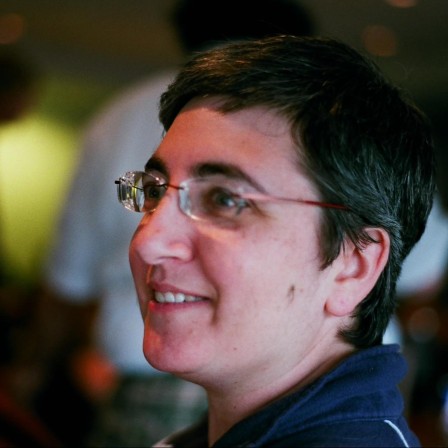
Working for Awesome Motive as a WordPress Developer and researcher, Mika helps make the internet safer for everyone. Until 2023, she was the lead rep for the WordPress.org Plugin Review team, and currently retains an advisory position. When she’s not writing her own code, she’s helping WordPress developers write something better.
The cofounder of LezWatch.TV, the greatest database of queer characters and shows, she develops software and trawls queer representation on television to make the data visible.
Passionate about code, open source technology, open data, and mindful development practices, Mika may watch a lot of TV but it’s for a good cause. You can find Mika travelling internationally to speak about the intersection of software, fandom, and humanism.
Q&A with Mika
Who or what helped you find your footing in WordPress, and how do you try to pay that forward today?
A Canadian reached out a hand back when I was living in the USA, stuck on a bizarre Multisite (then WPMU) problem. That single moment sparked a chain reaction that completely changed my life, from my very first WordCamp in Montreal to Keynoting at Atlanta and speaking at WCEU, US, and Tokyo! I try to pay that forward by seeking out people tangled up in weird, obscure technical questions. When I find a solution, I make a point to share it publicly. If I can smooth out the path so the next person stumbles a little less, I’ve done my job.
If you could engineer one connection at WCEH 2026 — a conversation, an intro, a collaboration — what would it be?
I would grab a couple long-time core contributors and some first-time attendees (specifically non developers) and have the core devs sit and listen to how WordPress is used in the real world. Where do the new people get intimidated, where are they scared, and where are they doing things the devs never dreamed of. When you’re developing, you’re often behind a curtain and you forget how the real-world uses your product. Not t his help the devs reconnect with the community, but it would show those new people that the devs are just normal people who also get stuck on weird bugs. Those kinds of connections can instantly transform a hesitant user into a lifelong community contributor.
WordPress powers 43% of the web, but it’s the people who keep it alive. What’s a moment in this community that reminded you why you stay?
Remember the Canadian who helped me with that Multisite problem? She eventually signed my paperwork so I could officially get my passport and move to Canada. That’s the magic of this group. Since 2020, we’ve all been through the wringer: pandemics, global turmoil, rising costs, wars, blockades, and burnout. Through every storm, this community keeps showing up for each other. Tools change and code gets refactored, but a network of people who literally help you start a new life in a new country? That’s why I stay.
What does the WordPress community get right that other tech communities don’t. What could we still do better?
Many tech ecosystems centre entirely around documentation and technical elitism. If you’ve ever used (or tried to use) AWS, you know how cryptic those things can be, and how high that wall is. WordPress, for better and for worse, has prioritized humans. Even in this age of AI, the question is less “How can I use AI to speed up work?” but “How can I use AI to make things better for users?”
We’re not perfect, and we need to keep doubling down on active listening. We need to remember to take a moment to breathe. Assume good faith. And remember that behind every screen, forum post, or pull request is just a human.
What’s a form of contribution you think is undervalued, and why does it matter?
We often treat code commits as the gold standard of contribution, but code doesn’t mean much if people can’t use it. Teaching someone a simple keyboard shortcut or writing clear, patient documentation does more to sustain our ecosystem than a million lines of elegant code. Code is just the engine but without the drivers it goes nowhere. If users don’t feel supported, understood, and able to do what they want, the product fails. Educating one person at a time is the quiet engine that actually keeps us moving forward.
A lot of people want to contribute but feel they’re not technical enough. What would you say to them?
I remind them that WordPress didn’t capture over 40% of the web because of its codebase. No, it won because of its people. If you know one single thing someone else doesn’t know, you are fully qualified to contribute. Can you answer a forum question? Translate a paragraph? Test a plugin and explain what felt confusing? Organize an event banner? That is vital work. We have plenty of people writing code. What we need are people who understand people, who listen and care and want to help. Some of those people also write code, but others come back and explain why the code directions are confusing. We need both of them. If you like WordPress and care about helping other humans navigate it, you not only belong here, you’re a contributor. Welcome.